Gross profit: What is it and how to calculate it?

Gross profit is a measurement that can help show how efficiently your business turns products and services into profit. Knowing how to calculate gross profit can give you a better sense of the financial health of your business and how effectively your company is using resources during business operations.
Continue reading to learn more about gross profit and how to calculate it.
What you’ll learn:
-
Gross profit measures profitability by focusing on product-specific costs.
-
To calculate gross profit, subtract the total cost of goods sold (COGS) from the total revenue.
-
Small-business owners (SBOs) can calculate gross profit to assess how efficiently their business uses labor and material costs and to identify which products and services are most profitable.
-
Along with gross profit, metrics like gross profit margin, net profit, EBITDA and operating profit provide further insight into a business’s profitability to better evaluate its overall financial health.

What is gross profit?
Gross profit is how much profit a business earns after subtracting the total costs of producing and selling its products or services. It can sometimes be referred to as sales profit or gross income, and it’s typically listed as a line item on a business’s income statement. It’s calculated by subtracting COGS from sales revenue. This simple formula helps measure the value your products or services bring to the business.
What is the formula for gross profit?
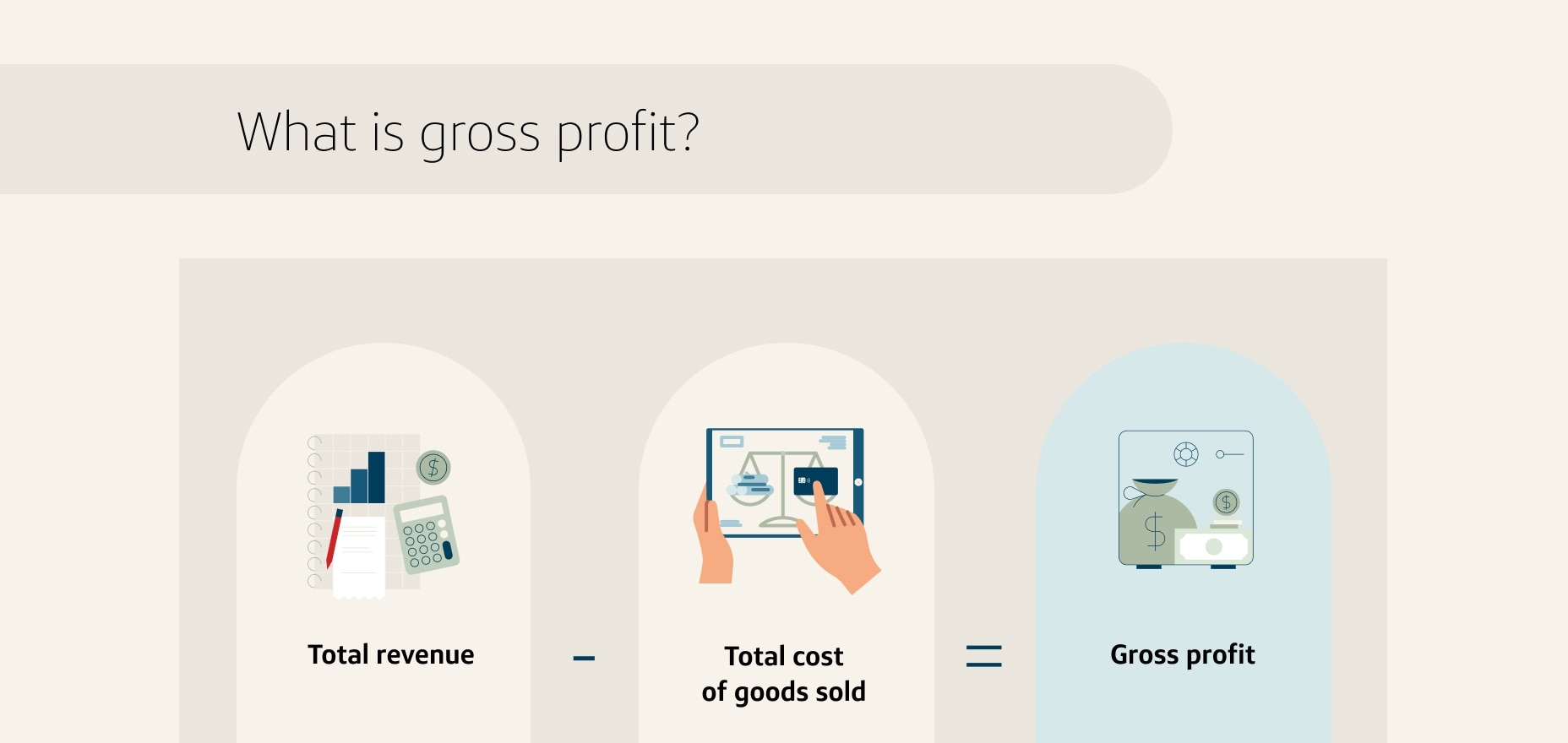
The formula to calculate gross profit is total revenue minus COGS.
Total revenue − COGS = Gross profit
Here’s a closer look at the key components of the gross profit formula:
-
Total revenue: The amount of money earned from the sale of your business’s products or services. This figure usually isn’t adjusted to account for business expenses—like overhead, taxes or interest—it only reflects the money earned from sales.
-
COGS: The direct costs associated with the production of a good or service. This typically includes variable costs—or those that change as production output changes—such as labor costs for staff directly involved in production. COGS can also include costs associated with producing or manufacturing a business’s products or services, like materials, packaging, shipping and equipment operation costs.
Gross profit calculation example
As an example of calculating gross profit, consider a donut shop that had $209,060 in total revenue and $122,155 in COGS. In this example, the total gross profit for the first quarter of 2026 is $86,905 using the following calculation:
$209,060 − $122,155 = $86,905
With this business, variable expenses include raw materials for making the dough, along with icing, coffee drinks, paper goods, cups, lids, toppings and add-ons, and wages. To calculate gross profit of the entire business for the first quarter of the year, you need to total the revenue and then subtract the variable costs (COGS).
The spreadsheet to calculate the gross profit might look something like this:
Imaginary Donuts Inc.: Gross profit calculation (Q1 2026)
| Category | Description | Amount ($) |
| Revenue | Donuts | 90,560 |
| Coffee | 78,500 | |
| Specialty orders | 40,000 | |
| Total revenue | 209,060 | |
| COGS (Variable costs) | Ingredients for dough | 18,670 |
| Ingredients for icing | 10,050 | |
| Coffee beans | 16,065 | |
| Toppings and add-ons | 10,000 | |
| Paper bags | 3,700 | |
| Napkins, cups and lids | 5,000 | |
| Wages for staff (production roles only) | 58,670 | |
| Total COGS | 122,155 | |
| Gross Profit | Revenue - COGS | 86,905 |
Why is gross profit important?
Gross profit can be an important metric for SBOs to calculate because it can be an indicator of a company's overall financial health. It shows how much profit a business’s offerings generate before accounting for operating expenses. It also highlights how efficiently the business manages production costs. A high gross profit can suggest that product or service pricing, production processes and material choices are contributing to strong profitability.
Investors might also ask about a business’s gross profit to evaluate how the company manages its production costs and overall profitability. And this metric can be used by both SBOs and investors to understand the impact of price changes on profitability.
Gross profit can also reveal whether a product is worth selling. A low gross profit may signal a need to improve production, renegotiate supplier contracts or discontinue the item. Insights into gross profit can also inform larger decisions about things like managing cash flow during downturns or reinvesting after a strong quarter.
How does gross profit compare to other financial metrics?
Gross profit is measured by subtracting COGS from revenue, which, compared to other financial metrics, provides a narrower lens of profitability related to products and services. Comparing gross profit to other data points—like gross profit margin, net profit, EBITDA and operating profit—can provide different insights into pricing strategy, cost structure or operational efficiency. And when reviewed with other metrics, gross profit can help you better understand how a company is performing overall.
Gross profit margin
Gross profit margin is identified as a percentage or ratio, whereas gross profit represents a fixed dollar amount. And while similar in name, gross profit and gross margin shouldn’t be used interchangeably.
Since a company’s gross profit can vary depending on factors like company size and industry, most businesses calculate their gross profit margin to get a better sense of their business performance. Gross profit margin indicates the percentage of your business revenue that is profit, and it’s helpful when comparing your business to other businesses in the industry.
To calculate your gross profit margin, divide your gross profit by your total revenue and multiply it by 100:
Gross profit ∕ Total revenue ✕ 100 = Gross profit margin
Net profit
Net profit, or net income, measures profitability after all expenses—not just product-specific costs—whereas gross profit only considers COGS. Gross profit could be a better indicator of how efficiently a company uses labor and supply costs to produce its goods and services. Net profit, on the other hand, provides a more realistic picture of overall profitability.
Earnings before interest, taxes, depreciation and amortization (EBITDA)
EBITDA takes a broader view of a business’s financial performance than gross profit does by factoring in operating expenses, while excluding financing and accounting decisions. While gross profit evaluates product-level margins, EBITDA is often used to assess overall operational performance and cash flow potential.
Investors and lenders frequently consider EBITDA when comparing companies across industries, as it removes factors such as taxes and financing decisions. This makes it easier to compare companies on an apples-to-apples basis.
Operating profit
Operating profit looks deeper into how profitable a business is by subtracting costs like rent, salaries or marketing from gross profit. So, in short, if you want to know whether your product or service is working, look at gross profit. If you want to know whether the business as a whole is running efficiently, look at operating profit.
While gross profit and operating profit both show how much money a company is making, gross profit is more of a quick check on whether your core offering is profitable. Operating profit provides a more detailed view by accounting for everyday business expenses, too.
Gross profit FAQ
Here’s more information about what gross profit is and how it compares to other financial metrics:
Should gross profit be higher than net profit?
Yes, gross profit is almost always higher than net profit. That’s because gross profit only subtracts COGS from revenue, whereas net profit accounts for all operating expenses beyond COGS, such as taxes, insurance and administrative costs.
Is total revenue the same as gross profit?
No, total revenue isn’t the same as gross profit. Total revenue is generally considered the “top line” because it’s the amount of money generated from sales—before subtracting expenses. Gross profit is how much money remains after COGS are subtracted from total revenue.
What is a good gross profit margin?
A good gross profit margin can vary depending on the industry. The overall average for gross profit margin across markets is around 30%, but this number can vary depending on the sector. For example, the average gross profit margin for online retailers is 42.53%, whereas the average gross profit margin within the automotive and truck industry is 9.04%.
What are the limitations of gross profit?
Gross profit can help explain higher-level elements of profitability related to products and services, but it doesn’t provide a complete picture of a company’s overall financial health. To get the full picture, companies can look at a variety of financial metrics. For service-based businesses in particular, gross profit may provide a less complete view of profitability because many service-related costs aren’t always captured in COGS. That’s why companies may also look at operating expenses and other financial metrics to better understand their overall financial landscape.
Key takeaways
Knowing your business’s gross profit can help inform important business decisions, which could be key to your company’s success. When you understand which goods and services are most profitable—and by contrast, which ones are straining your earnings—you can gain clearer insight into how your business is performing overall. This means you may be more empowered to make strategic decisions—whether they’re about growing your business, weathering hard times or developing a plan to improve performance.
Looking for more ways to help your business? Compare business cards from Capital One Business and see what you’re pre-approved for before applying—with no impact on your personal credit score.