How to open a business bank account

Summary
- Opening a dedicated business bank account separates personal and company finances, preserving legal liability protections, simplifying tax preparation and establishing an independent financial footprint for future borrowing.
- Account setup generally requires gathering key identification and legal documentation based on entity type—including an EIN or SSN, government photo ID, business licenses and state formation documents or operating agreements.
A business checking or savings account can provide a number of benefits to your growing small business. Opening a business account can help support legal compliance, simplify recordkeeping and provide benefits for both customers and employees. Keep reading to learn more.
To open a business bank account, start by choosing a bank that fits your needs, gather the required documents (including your Employer Identification Number (EIN) or Social Security number (SSN) for sole proprietors), and apply online or in person. You’ll need to submit your documentation and may be required to make an initial deposit to fund the account.

Why should business owners open a business bank account?
Opening a business bank account is important for several reasons, including (but not limited to) the following:
- Keeps business and personal finances separate
- Simplifies tax preparation and recordkeeping
- Supports legal liability protection
- Helps track and manage cash flow more accurately
- Makes payment processing easier
With a business bank account, business owners can streamline operations, separate their finances and support their businesses as they grow.
How to set up a business bank account
Setting up a business bank account is generally a straightforward process. While specific requirements can vary by financial institution and business type, most business owners can open an account in just a few steps.
Compare banks and account features
Different banks offer different benefits, so it’s worth comparing options. Before opening an account, take time to evaluate which bank best fits your business needs. Look at factors like:
- Monthly fees
- Minimum balance requirements
- Transaction limits
- Available digital tools and features
You may also want to consider customer support options, branch and ATM access, and how easily the account integrates with your existing tools or workflows. Choosing the right bank can help support your business as it grows.
Choose the right account type
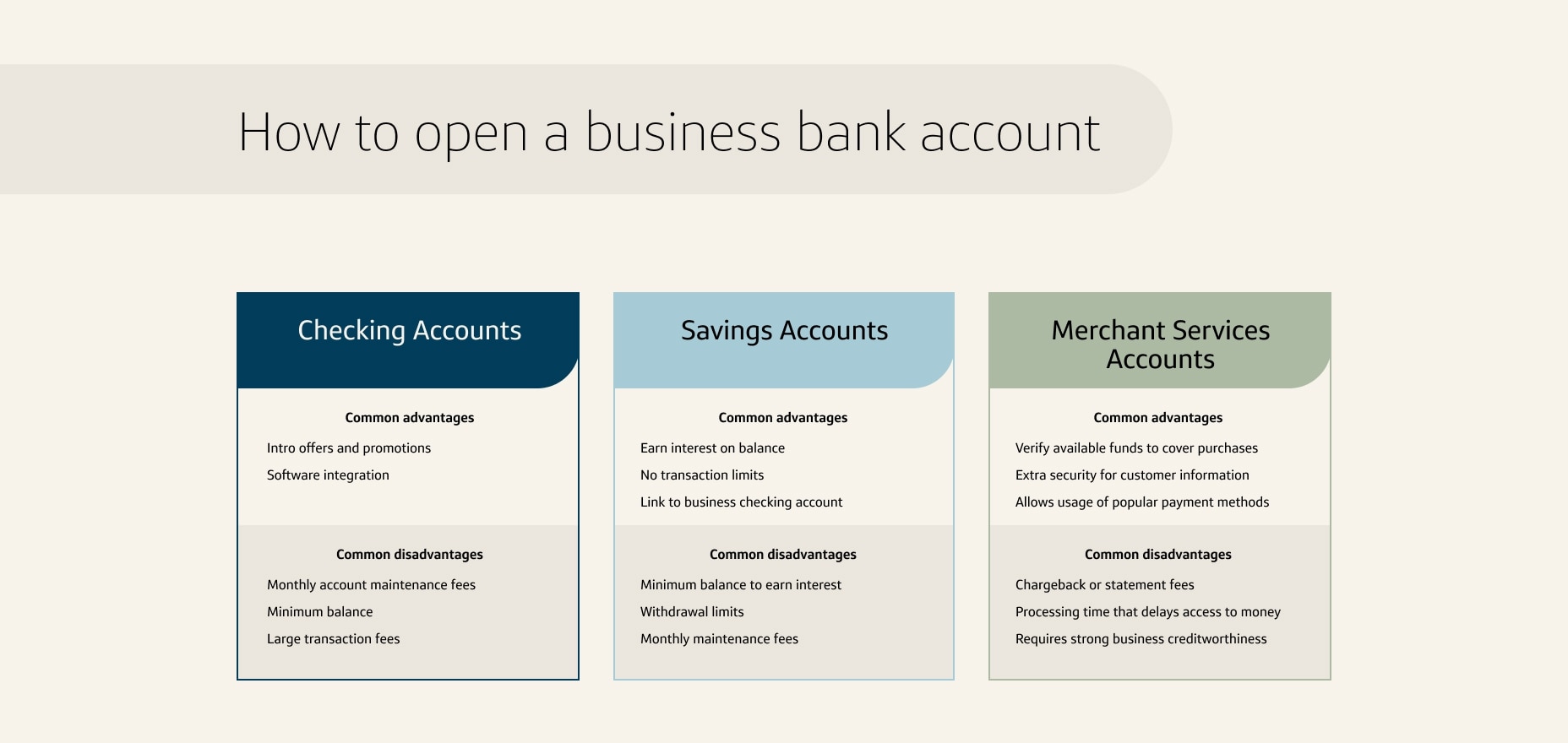
There are several different types of business bank accounts you can choose from, each with its own benefits, features and considerations. The terms can vary depending on the financial institution.
- Business checking accounts: Opening a business checking account is similar to opening a personal one. A business checking account can help you manage your business expenses while keeping your personal expenses separate. These accounts typically allow you to make deposits and withdrawals, write business checks, make wire transfers and use a business debit card to make purchases or withdrawals. They are also usually insured by the Federal Deposit Insurance Corporation (FDIC) for up to $250,000.
- Business savings accounts: Savings accounts for businesses are also similar to consumer savings accounts, with the opportunity to grow your money with attractive APY rates, and are typically FDIC-insured up to $250,000.
- Merchant services accounts: Merchant services accounts allow your business to accept and process debit and credit card payments. Merchant services accounts are typically linked to your primary business bank account, and they verify funds before depositing them into your primary account. They charge a fee per transaction, usually a percentage (such as around 1.5% to 3.5%) of the transaction amount.
Gather required documents
You will need business documentation to open a business bank account, in addition to the EIN and other basic personal information.
Most businesses will need some combination of the following to open a business bank account:
- Tax identification number: EIN or SSN, depending on business type
- Government-issued photo ID: valid photo identification for the business owner or authorized signer
- Business license or registration: business license and/or “doing business as” (DBA) registration
- Formation documents: articles of incorporation, certificate of organization or similar state registration paperwork
- Governing documents: operating agreement, partnership agreement or corporate bylaws
- Business details: including industry type, contact information and establishment date
- Ownership structure: details like percentage of ownership and number of owners or employees
Apply and get started
Once you’ve selected a bank, you can typically apply online or in person with a business banker.
Usually you’ll be asked for information about your business and its owners. Some banks may approve your account quickly, while others might take a few days to review your information. Once your account is approved, you’ll typically need to make an initial deposit to activate the account.
The amount of the initial deposit may vary by financial institution and account type. For example, a business savings account may require a higher initial deposit than a business checking account. Most initial deposits can range from $5 to $1,000 and may align with the account’s minimum required balance.
Requirements by business structure
The requirements to open a business bank account can vary depending on how your business is set up. Here’s a general breakdown:
| Business structure | Typical requirements |
| Sole proprietorship |
|
| Partnership |
|
| LLC |
|
| Corporation |
|
Key takeaways
As a business owner, you’ve got a busy life. Between adjusting pricing strategies and maintaining positive client relationships, there isn’t much room for sorting through scrambled finance records or mixed expenses.
A business bank account may make your life easier by separating your personal and business finances and simplifying financial management.
At Capital One, each business is unique and deserves unique banking solutions. Explore business checking products from Capital One, which offer convenience, control and features designed to support your business.