How a Capital One investment helps communities thrive
Two New Markets Tax Credit investments—in Memphis and metro Detroit—show how capital helps organizations serve more people.
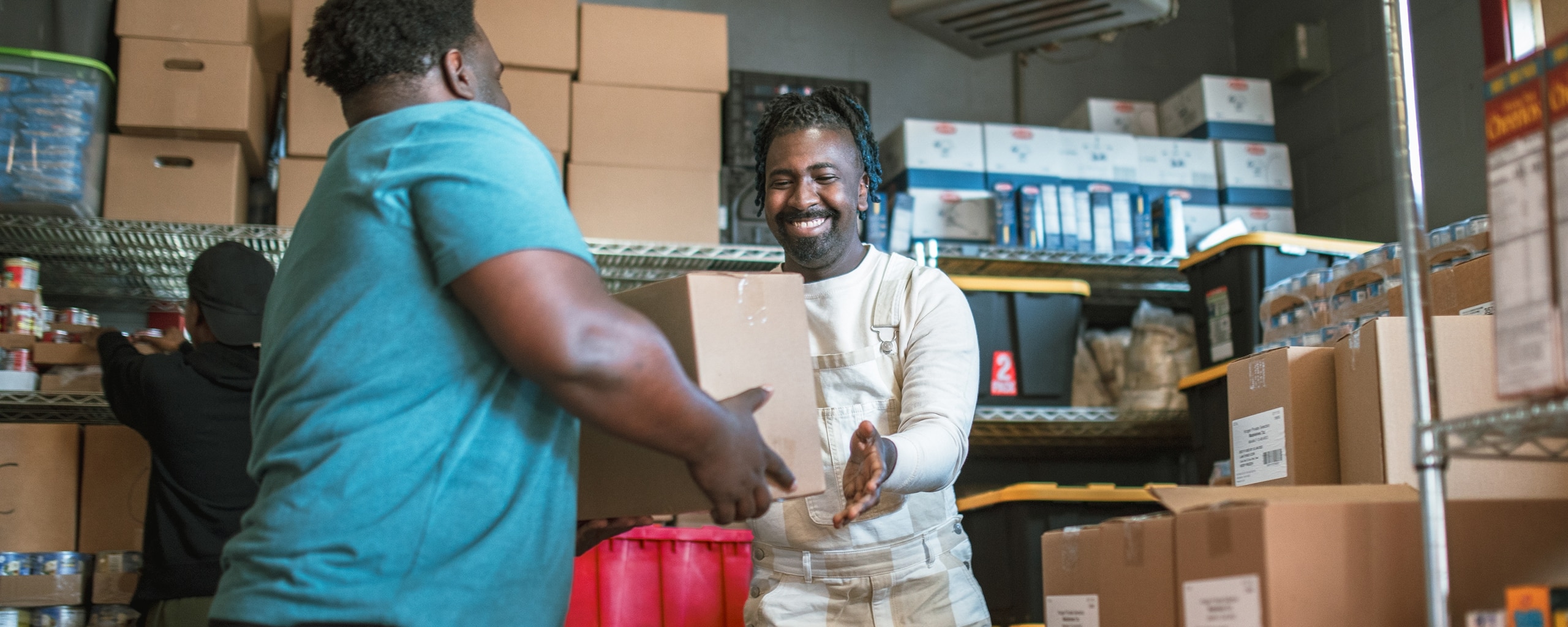
Some of the communities that need capital most are the ones least likely to attract it. Neighborhoods with high poverty, limited economic opportunity and aging infrastructure often sit outside the reach of conventional financing. The organizations that work hardest to serve them often face a familiar bind: the need is greatest precisely where the resources are scarcest.
That's the gap Capital One works to close. As an investor in the federal New Markets Tax Credit (NMTC) program, Capital One puts capital to work in communities that meet federal distress thresholds by providing financing for facilities and businesses those communities depend on, lowering the cost of building and operating them in the process.
Two recent investments—one just outside Detroit, Michigan (in Taylor), and the other in Memphis, Tennessee—show that capital investment means more than just buildings. It can translate into more meals served, more people housed, more jobs created and more neighbors connected.
What a community investment makes possible
Because NMTC financing lowers a project's cost of capital, it expands what an organization can accomplish. With less higher cost debt to service, organizations can make decisions based on community need rather than financial constraint. As a result, they can invest in quality, designing for dignity and building for the long term. A Capital One investment signals credibility to other funders, so it often brings additional philanthropic and private capital to the table.
“Our job as an investor is to put capital where conventional financing won't go,” says John Chamberlain, a Capital One managing director and head of tax credit finance. “When we lower the cost of building in a distressed community, an organization can stop designing around its budget and start designing around the people it serves.”
Gleaners Community Food Bank: feeding a region, building careers
In southeastern Michigan, Gleaners Community Food Bank now moves food on a significantly larger scale compared to just a few years ago. In 2024, volunteers worked some 54,000 hours across five counties distributing about 50 million pounds of food and more than 850,000 gallons of fresh milk (one of the most requested items). A network of 350 partners and 39 schools stock that food into pantries, shelters, soup kitchens and classrooms.
The scale of the distribution is possible thanks to Gleaners' South Campus in Wayne County, which has the highest food insecurity rate (17.6%) in the food bank’s service area. In the census tract around the campus, the need is even greater. The unemployment rate is more than twice the national average, median family income is just 68.6% compared with the surrounding area, and the poverty rate is 31.8%. It is a USDA-designated food desert and a Qualified Opportunity Zone.
Capital One's $17 million NMTC investment allowed Gleaners to acquire and rehabilitate a 180,000-square-foot refrigerated warehouse. The investment enabled the organization to expand its capacity substantially, going from two non-refrigerated loading docks to 24 refrigerated ones. Drivers can stage loads in advance and complete multiple runs a day. Freezer space tripled, to 21,000 square feet, and cooler space expanded almost fivefold, to 30,000 square feet. The South Campus now has the capacity to distribute as much as 80 million pounds of food a year, the kind of surge capacity that proved vital during the COVID-19 pandemic and which continues today.
The investment supports 39 permanent full-time-equivalent jobs. All are quality positions with comprehensive benefits, including health insurance, retirement and access to Gleaners' Mobile Grocery program to ensure no employee faces food insecurity themselves. Ninety-two percent of those positions are open to people without a college degree, a deliberate strategy to keep opportunity within reach of the community Gleaners serves.
Memphis Union Mission: serving more people, with dignity
The benefits of Capital One’s NMTC investment are also felt in Memphis, Tennessee, where for 24 years, Memphis Union Mission's (MUM) prided itself on never turning anyone away for lack of space. The facility now accommodates more than 350 guests a night.
In 2019, the Mission was worried that it might not have the capacity to meet the growing needs of the surrounding community. Memphis has a citywide poverty rate of 22.6%, well above the state average, and the area around the mission is even greater(51.7%). Studies estimated the city’s homeless population at 1,292, but MUM’s facility could serve only 65 people.
Capital One's $34 million NMTC investments helped fund MUM's Opportunity Center—an 82,644-square-foot, two-phase expansion in downtown Memphis. Phase 1 opened in 2021 and Phase 2 in 2023. The investments not only expanded the building’s scale, but they also helped shape its character. Freed from financing constraints, MUM designed for dignity, adding soundproofing, quiet spaces and private showers, all chosen to reduce stress for guests managing behavioral health challenges. The facility deliberately avoids the institutional “day room” model in favor of spaces where guests can find privacy, join programming or simply decompress.
In 2024, Memphis Union Mission's Opportunity Center helped 1,841 guests, providing 78,885 nights of lodging and serving 273,853 meals.
The investment also enabled the Opportunity Center to provide health care services it previously could not. In 2024, 670 guests received medical appointments on-site, 403 received psychological assessments and 61 met with a dedicated on-site case manager. The Mission also supports 19 permanent full-time-equivalent jobs, directed 95% of its construction contracts and subcontracts to local vendors and received 9,461 volunteer visits in 2024. Its leaders believe that volunteer engagement serves as a community-building force in itself, connecting Memphis residents with neighbors they might otherwise never meet.
The pattern behind the projects
Gleaners and Memphis Union Mission are different organizations, serving different people in different cities. But their stories share a common thread of distressed communities with documented need, organizations with the mission and the model to meet it and an investment that made it possible to build something worthy of the people it serves. In both cases, Capital One's capital attracted additional funding. In both cases, the result is a community anchor that creates jobs, engages volunteers, strengthens partner networks and builds capacity that will serve its community for decades.
“The square footage for these projects isn't what I measure," Chamberlain says. “It's that in Memphis, no one is turned away, and in Michigan, a family has fresh milk on the table. That's the return that matters—and it's why we keep investing in this work.”
That's what patient, well-structured community investment can do—and it's why Capital One remains committed to putting capital to work where it matters most.
Learn more about Capital One’s commitment to building stronger, more resilient communities through the New Markets Tax Credit program.