Advancing safe agentic AI: ASKS symposium highlights
Highlights from UIUC's 2026 ASKS Fall Symposium.

On September 24–25, academic researchers, enterprise scientists and leaders gathered at the Thomas M. Siebel Center for Computer Science at the University of Illinois Urbana-Champaign (UIUC) for the ASKS Fall Symposium.
The event marked a major milestone in the partnership between Capital One and the University of Illinois through the Capital One Center for Generative AI Safety, Knowledge Systems, and Cybersecurity (ASKS). Designed to advance the safety, reliability and security of generative AI models, the symposium featured keynotes, research readouts, panel debates and a hands-on AI red-teaming workshop.
From models to agents: Navigating the age of action
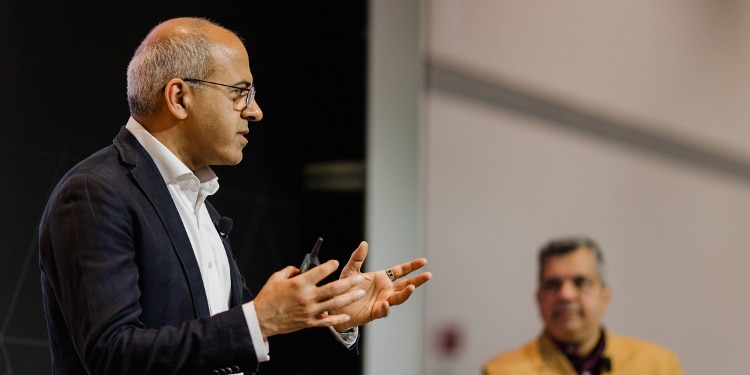
The symposium kicked off with opening remarks and a fireside chat titled "From models to agents: rethinking AI research, safety, and cybersecurity in the age of action." Moderated by ASKS Co-Director Heng Ji, the session featured Prem Natarajan, chief scientist and chief enterprise AI officer at Capital One, alongside Nancy Amato, director of the Siebel School of Computing and Data Science.
The discussion framed the fundamental transition taking place across the AI landscape: moving away from models that merely generate text to autonomous agentic AI—systems that can set goals, execute code, operate tools and take multistep actions.
Natarajan highlighted Capital One's "destination-back" scientific approach, emphasizing that in highly regulated spaces like financial services, autonomous agency requires rigorous safety mechanisms. As AI stops just "talking" and starts "acting," industry-academic partnerships like ASKS become essential to build new sandboxing, auditing and accountability frameworks.
Panel spotlight: Word models vs. world models
One of the highlights of the day was a panel exploring the fundamental limits of current large language models: "Word models vs. world models: Do LLMs understand the world—or just describe it?"
Moderated by Heng Ji, the panel brought together UIUC faculty members Gang Wang, Julia Hockenmaier, Chengxiang Zhai and Katie Driggs-Campbell alongside Capital One AI leaders Sambit Sahu and Yue (Rex) Wu. The panelists debated whether modern foundation models genuinely comprehend real-world dynamics or simply replicate statistical language patterns. The consensus pointed toward a need for multimodal visual grounding, physical intelligence and trace-aware reasoning to move models from passive text descriptions to true situation understanding.
Pioneering research readouts
Throughout the symposium, awarded faculty members and doctoral fellows presented breakthrough findings from ASKS-funded research projects spanning safety, code reasoning and cybersecurity:
-
LLM reasoning and faithfulness: Hao Peng presented work on advancing reasoning faithfulness without explicit rewards, while Talia Ringer's team introduced TrACE-Contrast for faithful code reasoning. Yuxiong Wang presented work on building safe and trustworthy LLM-based agents by addressing key challenges in evaluation, privacy preservation and multi-agent coordination.
-
Guaranteed safety for agentic AI: Sasa Misailovic detailed SafeAgency, a framework designed to guarantee safety in agentic workflows, complemented by Katherine Driggs-Campbell's analysis of failures in agentic systems.
-
Security and cybersecurity benchmarks: Bo Li's team showcased Sentinel Agent for secure agentic architectures, Varun Chandrasekaran's team presented insights into pragmatic LLM jailbreaking and Daniel Kang introduced CVE-Bench++, a benchmark for evaluating AI agents in cybersecurity contexts.
-
Keynote on code generation safety: ASKS Director Gang Wang delivered a keynote on automated red-teaming and reasoning to secure code generation models.
-
Doctoral fellow spotlights: Emerging researchers Hyeonjeong Ha, Jeonghwan Kim, Yizhuo Chen, Cheng Qian and Chenyuan Yang presented research on perceptual grounding, data sanitization and physical intelligence.
The afternoon program highlighted Capital One's research initiatives during a session chaired by Sambit Sahu, featuring lightning talks by senior research directors Kartik Balasubramaniam, Genta Winata and Stephen Rawls on scalable AI foundations and system architecture.
Red-teaming workshop
On the second day of the event, domain specialists convened for a smaller, more intimate AI red-teaming workshop. Alexandre Day (Capital One), Sriram Venkatapathy (Capital One), Varun Chandrasekaran (UIUC) and Gang Wang (UIUC) organized technical talks and working group sessions across three primary focus areas:
- Novel and diversity-driven red-teaming: Led by Capital One's Sriram Venkatapathy, the session examined how financial AI systems must adhere to strict multilayered policy frameworks—spanning federal regulations (e.g., FCRA, UDAP), enterprise governance and application-specific constraints. Discussions highlighted that evaluating enterprise safety requires detecting policy omissions (such as missing mandatory disclosures or consent prompts) as well as defending against strategy-conditioned jailbreaks, chain-of-thought forgery and loopholes in complex policy specifications.
- Red-teaming multi-agent systems: Led by Gang Wang, this track focused on security vulnerabilities unique to multi-agent architectures. Researchers analyzed risks such as indirect prompt injection across workspace topologies, lateral attack propagation between trusted agents, execution-level coordination failures (e.g., data races and deadlocks) and communication-layer enforcement via protocols like NLIP.
- Evaluation of red-teaming and LLM judges: Led by Rikhiya Ghosh, participants tackled the open challenges of scientifically evaluating safety across long-horizon, multiturn interactions. The group audited LLM-as-a-judge frameworks using semantic factorization (MoE judges), probed reasoning traces for stealthy deception and monitorability failures and explored methods to prevent benchmark contamination through dynamic case generation.
Fostering the frontier of talent and research
The partnership between Capital One and UIUC continues to drive technical innovation while training the next generation of scientific talent. Highlighting joint breakthroughs like MEMGUARD—a defense mechanism preventing memory contamination in LLMs—the ASKS Center demonstrates the power of combining academic exploration with industrial scale.
Capital One looks forward to continuing this strategic collaboration, advancing research in agentic AI and building systems that remain secure, trustworthy and beneficial at scale.
Learn more about Capital One Science
- Explore the Capital One Science blog.
- Read our AI research publications.
- Discover career opportunities.